

Quick question: when did you last hear someone say “I saw it on Twitter” and actually mean Twitter? Chances are, half your feed has quietly slid over to Threads without you even noticing the switch. That shift is exactly why the threads app vs twitter comparison has stopped being a niche tech debate and turned into something brands, creators, and everyday scrollers are all asking about in 2026.
Both apps still do the same basic job — short posts, replies, a feed that updates fast. But spend a week on each one and the differences show up almost immediately, from how the algorithm treats your posts to who’s actually showing up to reply. This threads app vs twitter comparison breaks down what’s changed, what hasn’t, and which platform actually deserves your time right now.
What Triggered the Threads App vs Twitter Comparison This Year
Threads, built by Meta and tied directly to Instagram, launched on July 5, 2023. It picked up 100 million sign-ups in five days, a speed no app had managed before, and it did it by quietly riding on top of Instagram’s existing user base instead of starting from zero.
X, the platform almost everyone still calls Twitter out of habit, has been around since 2006. It went through a name change and a full ownership shift after Elon Musk’s 2022 takeover, and that shift is still shaping how people talk about it. Some of the platform’s most-discussed moments in 2026 haven’t been about features at all — they’ve been about moderation controversies, including investigations opened by regulators in several countries over misuse of the platform’s built-in AI tool.
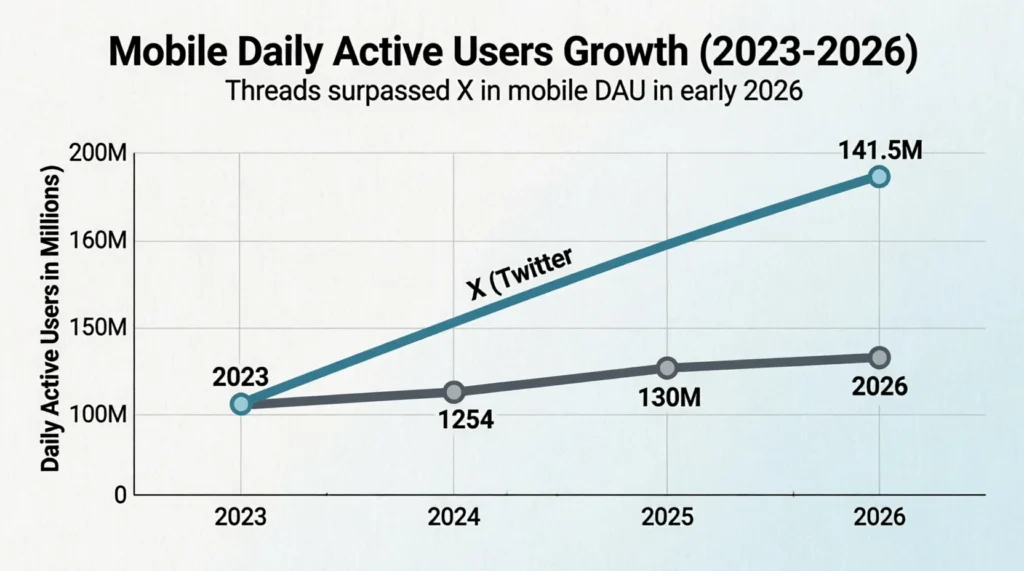
So when Similarweb data reported by TechCrunch showed Threads pulling ahead of X on mobile daily active users in early January 2026, it wasn’t a fluke headline. Similarweb’s data shows that Threads had 141.5 million daily active users on iOS and Android as of January 7, 2026, while X had 125 million daily active users on mobile devices. That gap had been closing for months, not days.
Threads App vs Twitter Comparison: Feature-by-Feature
Numbers aside, the day-to-day experience between these two apps still feels pretty different. Here’s a quick side-by-side of what actually shows up when you open each one.
| Feature | Threads (Meta) | X (Formerly Twitter) |
|---|---|---|
| Character Limit | Up to 500 characters | 280 characters (Free tier) |
| Sign-up Process | Requires an Instagram account | Standalone email/phone sign-up |
| Feed Algorithm | Relationship & reply-based | Speed, recency & network size |
| Live Events | Not supported | Live audio/video (Spaces) built-in |
| Monetization | Newer, limited creator program | Subscriptions, ad revenue sharing |
- Character limit: Threads allows posts of up to 500 characters; X caps free posts at 280.
- Sign-up: Threads requires an existing Instagram account. X is a standalone sign-up.
- Feed logic: Threads leans on relationship and reply signals. X leans on speed, repost velocity, and network size.
- Live events: X still has a dedicated live audio/video presence built into the core app. Threads doesn’t compete here.
- Messaging: Threads added direct messaging and long-form text features over the past year, closing a gap that used to be one of its biggest weaknesses.
- Monetization: X has a more developed stack — subscriptions, ad revenue sharing, paid verification. Threads’ creator program is newer and, as of this writing, more limited in where it’s available.
None of this makes one app objectively “better.” It just means the two have been built around different habits, and that’s the heart of every honest Threads vs. X breakdown you’ll read this year.
Where Threads Actually Wins
Anyone who’s run accounts on both platforms for more than a few weeks tends to notice the same thing: Threads feels calmer, and that calm translates into real numbers.
A small account on Threads can still get noticed because there’s less noise competing for the same reply. Brands sensitive to where their name shows up have also gravitated toward Threads because the moderation tone is steadier, with fewer of the brand-safety headaches that have pushed some advertisers off X over the past couple of years.
Threads also benefits from something most competitors can’t replicate: it’s one tap away from roughly two billion Instagram accounts. That cross-promotion is the entire reason Threads could grow as fast as it did without spending a dime acquiring users the traditional way.
Where X Still Pulls Ahead
X hasn’t been standing still, even with all the noise around it. The platform still owns real-time conversation in a way Threads doesn’t even attempt to compete with. Breaking news, live sports reactions, political debate, market-moving commentary — that all still happens on X first, and it happens fast.
Browser-based usage is the clearest gap of all. As of January 13, 2026, X was seeing 145.4 million daily web visits, while Threads saw 8.5 million daily web visits across Threads.com and Threads.net combined. Journalists, researchers, and anyone who works from a desktop most of the day still default to X, hashtags and all.
X also keeps a feature set Threads hasn’t matched: live audio Spaces, an established Lists function, a paid API tier that scheduling and analytics tools plug into, and search filters that go far beyond what Threads currently offers. For startups and power users who depend on that kind of tooling, X is still the safer, more complete option.
What the Research Shows
Looking closely at how each platform has grown tells a story that goes past the headline mobile-usage flip. Threads crossed over 400 million monthly active users as of Q3 2025, and Meta has since said the platform reached 500 million monthly active users by June 2026, less than three years after launch.
X, meanwhile, hasn’t disappeared — it still pulls a larger combined audience once web and mobile are added together. But the trend line matters more than the snapshot. Threads’ mobile growth has been described by researchers tracking both platforms as steady rather than spiky, built on cross-promotion and feature updates rather than a single viral moment. That kind of growth tends to stick.
Industry analysts watching ad spend have started shifting language too, noting that platforms with rising daily habits — not just raw size — are where marketing budgets tend to follow next. That shift is exactly why the threads app vs twitter comparison keeps showing up in marketing meetings, not just casual app-store debates.
Who Should Actually Use Which App
This isn’t really an either-or decision for most people, but the right starting point depends on what you’re trying to do.
If you’re a creator selling something through DMs, building trust slowly, or working in lifestyle, books, wellness, or culture niches, Threads tends to reward you faster simply because there’s less competition for each reply. If you’re a journalist, a trader, a developer, or anyone whose job depends on knowing what’s happening right now, X is still the place that surfaces it first.
A typical brand running both accounts at once handles it like this: post the calmer, conversation-starting version of an idea on Threads, then post the faster, punchier version on X when something’s actually breaking. Treating both as the exact same feed wastes the strengths of each one.
The Part of This Comparison Most Articles Skip
Most comparisons between these two apps stop at features and user counts. The part that gets skipped is mood, and mood is sticky.
People who’ve used both apps for a few months consistently describe X as the place where arguments happen and Threads as the place where conversations happen. That’s not a knock on either app — some days you want the argument, especially if you’re trying to ride a trending topic. Other days you want a reply thread that doesn’t turn into a fight by the third comment. Choosing a platform based on the mood you actually want, not just the feature list, is the piece most comparisons leave out entirely.
Threads App vs Twitter Comparison: Final Verdict for 2026
There isn’t a single winner here, and pretending otherwise would be dishonest. The threads app vs twitter comparison in 2026 comes down to mobile habit versus desktop depth, calmer growth versus faster reach, and a newer creator-friendly app versus a longer-established one still working through a rough few years of public scrutiny.
Threads has earned its place as the more comfortable daily habit for a lot of mobile users. X still owns the moment when something big actually happens. Most people serious about either platform end up running both, just with different expectations for what each one is supposed to do.
Also Read: Tóris: A Deep Dive Into the Invisible Threads Defining Our Culture
FAQs
Is Threads actually bigger than Twitter (X) now?
Not overall. Threads has pulled ahead on mobile daily active users, but X still leads by a wide margin on desktop and web traffic, and X claims a larger total user base when every channel is counted.
Can I use Threads without an Instagram account?
No. Threads requires an existing Instagram login, and deleting your Threads profile currently means deleting your Instagram account along with it.
Does Threads have direct messages like Twitter?
Yes, as of the past year Threads added direct messaging and long-form text posting, closing two of the gaps that used to set it apart from X.
Which platform is better for breaking news?
X, by a clear margin. Its real-time, recency-driven feed still surfaces breaking events faster than Threads’ more relationship-based algorithm.
Should a small business pick one platform over the other?
Not necessarily. Many brands run both, using Threads for relationship-building and customer tone, and X for time-sensitive updates and public visibility.