
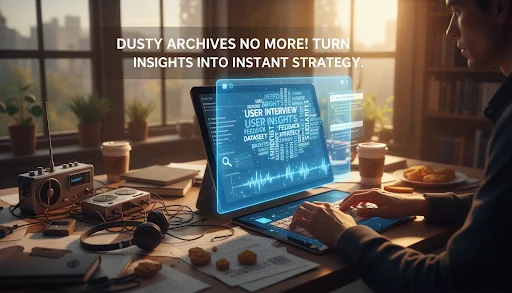
Ever finished a long day packed with user interviews, only to be left staring at a pile of recordings that you know you’ll never have time to sift through? We all gather these precious insights, thinking they are our safety nets, but the reality is often quite different. Often, our analysis just turns into a hasty recollection, almost a blur pieced together from shaky memories that lose their fidelity the moment the meeting ends. I’ve found that the shift toward a truly effective product strategy starts when we stop seeing these recordings as dusty archives and instead treat them as invaluable datasets, ready to be searched and scoured to make instant, solid decisions.
The Hidden Friction in Product Discovery Sessions
There is a specific kind of cognitive load that comes with managing a series of high-stakes stakeholder meetings or user tests. Recording stuff isn’t where the real struggle lies; it’s the inevitable slog after, when you’re left wrestling hours of chatter into a handful of bullet points for some stakeholder’s slide deck. I have noticed that in many organizations, the loudest voice in the room ends up winning simply because their comments were the most vivid or the easiest to recall during the write-up. This bias is a silent destroyer of quality design decisions, leading teams to prioritize the wrong features based on a skewed perception of the conversation. By the time you circle back to find a key quote to prove a point, the sprint’s already moved on, and you have missed the chance for that insight to actually make its mark on the product roadmap.
Moving Past the Limitation of Manual Note-Taking
I think we’ve all been in that position where we try to be the active listener and the meticulous scribe at the same time, only to fail at both. When you’re frantically typing, you miss the micro-expressions and the tone of voice that tell the real story of a user’s frustration. Moving past manual note-taking isn’t just about saving time; it’s about regaining the mental bandwidth to actually lead the session. By delegating the mechanical task of recording and documentation to a dedicated system, you allow yourself to be fully present, which almost always results in deeper, more meaningful follow-up questions that wouldn’t have surfaced if you were buried in a notepad.
Capturing User Sentiment Beyond the Script
There is something almost magical about dropping the burden of frantic note-taking and just focusing on the human in front of you. When you integrate a reliable audio to text converter into your workflow, the first noticeable shift isn’t just the time you save—though that is certainly a relief—but it’s more about how much better you can facilitate the actual discussion. Without the distraction of keeping pace with the speaker, you start catching those subtle hesitations and the non-verbal cues that represent real pain points. By capturing all the little “ums” and “ahs” in a full transcript, you can dive back into that emotional space later during the analysis phase. It gives you the evidence you need to move beyond what people said they wanted and into the territory of what they actually struggled with.
Transforming Conversations into a Competitive Dataset for Engineers
Once you have the text, the dynamic of the team starts to change from subjective interpretation to objective analysis. I’ve found that engineers and developers are much more likely to buy into a design change when they can read the raw feedback themselves rather than hearing it filtered through a product manager’s perspective. It turns the “research” into “data,” which is a language that the technical side of the house speaks fluently. This creates a more transparent decision-making pipeline where anyone on the team can verify the findings, fostering a culture of accountability and shared understanding that is rare in siloed organizations.
Why Searchability Matters More Than the Original Recording
We often overestimate our ability to find information in an audio file. Picture this: a developer is pondering why one UI element was chosen over another, but the only record is a forty-minute MP3 file. In that scenario, they are rarely going to listen to the whole thing to find the answer. However, if you have a searchable transcript archive, they can hop in and find the relevant keywords in seconds. This self-service method of gathering context separates the high-flyers from those caught endlessly clarifying simple points. By using an audio to text converter, you are essentially building a growing library of user interactions that becomes ever more precious with each new interview you conduct, turning your past efforts into a living knowledge base.
Bridging the Communication Gap Between Research and Code
Researchers often live in a world of stories and qualitative nuances, while engineers tend to prefer structured data and clear numbers. Transcripts act as the essential bridge between these two very different professional worlds. By offering a text file that developers can parse, tag, and even run through sentiment analysis tools, you are presenting feedback as something they can work with directly. This structural tweak ensures that when you point out that a feature is “confusing,” you aren’t just giving an opinion; you are backing it with fifteen specific, searchable moments of users saying just that. It makes advocating for fixes or redesigns during a heated sprint planning session a whole lot easier because the evidence is right there on the screen, ready to be copied and pasted into a bug report.
Optimizing Large Assets for Global Collaboration
In today’s globalized work environment, user research often involves rich, detailed videos that capture every interaction on a screen. The problem is that these files are massive, and trying to share them with a distributed team across different time zones can totally kneecap your productivity. I’ve found that the best approach is to be pragmatic about file management before the transcription even begins. For instance, it is often wise to use a video compressor to keep the visuals sharp enough for analysis but light enough to share without a technical headache. This stops the logistics of file sharing from slowing down your teamwork and ensures that the transcription process can start immediately, even if your team members are working on limited bandwidth in different parts of the world.
Ensuring Long-Term Institutional Memory and Accuracy
The final piece of the puzzle is how we handle this information over the long term. A project manager’s role is as much about curation as it is about creation. Once you ship a feature, a transcript’s role isn’t over; it becomes a form of insurance for the company’s institutional memory. I’ve seen teams lose incredible amounts of time re-learning the same lessons because the original research wasn’t documented in a way that survived a staff change. When someone new joins six months down the line, they don’t need lengthy catch-up meetings that drain everyone’s energy. They can simply skim the critical interviews and meeting transcripts to understand the “why” behind every design choice. It cuts down the onboarding duration and keeps the reasoning behind past choices clear, ensuring that your product strategy remains consistent and well-informed, even as the team evolves.