

A few years ago, paying for a hostel in Lisbon or a tuk-tuk in Bangkok with crypto was the kind of thing only early adopters attempted. Today, it is increasingly unremarkable. Travelers are using crypto to split costs across currencies, avoid airport exchange booths Crypto While Traveling, book accommodations on crypto-friendly platforms, and spend directly with a card linked to their digital wallet — just like any regular Visa or Mastercard.
The shift has been gradual but real. Crypto payment adoption among travel merchants has grown steadily, and the infrastructure around spending crypto in the real world has matured to the point where the main barrier for most travelers is no longer “can I use this?” but “where do I start?” This guide answers that question practically, covering the main use cases, what to look for in a crypto platform, and how to avoid the friction that still exists in some corners of crypto-meets-travel.
Why Travelers Are Reaching for Crypto More Often
The case for using crypto while traveling is not primarily ideological — it is logistical. Traditional currency exchange comes with fees that compound quickly. Bank card foreign transaction fees typically run between 1% and 3% per transaction, ATM withdrawal fees can add another fixed charge on top, and dynamic currency conversion at point of sale is a known trap that can cost another 2–5%. Over a month of travel, that adds up to a meaningful slice of a budget.
Crypto-based spending, particularly through a Visa-backed crypto debit card, sidesteps most of this. The card converts crypto to local currency at point of sale, the transaction processes through the Visa network like any other payment, and the underlying exchange rate is typically more competitive than what airport booths or hotel desks offer. For destinations that are still cash-heavy, ATM withdrawals through a crypto card work the same way.
Beyond spending, crypto also solves a specific travel problem that traditional banking handles poorly: sending money internationally in a hurry Crypto While Traveling. If a family member needs to send emergency funds abroad, a wire transfer takes days and costs $20–$50 in fees. A crypto transfer takes minutes and costs a fraction of that.
Real-World Use Cases for Crypto on the Road
1. Everyday Spending Without a Crypto Card
In cities with active crypto adoption — parts of Southeast Asia, Eastern Europe, Latin America, and major global hubs — you will find merchants who accept Bitcoin or USDT directly. Platforms like Travala allow you to book hotels and flights with crypto. Airbnb hosts increasingly list properties on crypto-friendly booking platforms. These options exist, but they require matching your travel plans to what accepts crypto rather than the other way around.
2. Everyday Spending With a Crypto Debit Card
This is the more practical route for most travelers and has become significantly more accessible in 2025–2026. A crypto debit card works at any terminal that accepts Visa or Mastercard, which means essentially anywhere you would use a regular card. You load the card with a stablecoin like USDT, and the card handles the conversion at point of sale. No merchant needs to know or care that crypto is involved. This approach gives travelers the full flexibility of card payments without the currency exchange friction.
3. Emergency Transfers and Splitting Costs
Traveling with a group across multiple countries often involves currency juggling. If you are tracking shared expenses in euros in Paris and then baht in Thailand, keeping a shared USDT balance is considerably cleaner than converting between currencies constantly. Splitting costs in stablecoin, with everyone paying back into a shared address, is increasingly how organized group travelers handle multi-destination trips.
4. Avoiding Banking Blocks Abroad
Many travelers have experienced the frustrating moment when their home bank blocks a transaction in an unfamiliar country, even after setting up travel notifications. Crypto accounts have no concept of geographic fraud triggers. If you have access to your exchange account or wallet, you have access to your funds — from anywhere.
What to Look for in a Crypto Platform for Travel
Not all exchanges are equally useful for travelers. The features that matter most in a travel context are different from what a futures trader prioritizes:
- Crypto debit card with Apple Pay and Google Pay support — physical card acceptance is broad, but contactless mobile payments are faster at checkout and increasingly preferred
- No mandatory KYC — being able to set up and start using a platform quickly matters when you are already on the road
- Stablecoin support — USDT and USDC are the practical travel currencies; you do not want your spending power to fluctuate with Bitcoin’s price mid-trip
- Global availability — your platform needs to function in the countries you are visiting, not just at home
- Responsive customer support — travel introduces time zones and urgency; a platform with fast human support matters more when something goes wrong abroad
BYDFi: A Platform Worth Knowing for Travelers
BYDFi is a Singapore-based crypto exchange founded in 2020, now serving over one million users across 190+ countries. It is probably best known for its Premier League connection — the platform is the official crypto exchange partner of Newcastle United Football Club — but for travelers, the most relevant feature is simpler: the BYDFi Visa Card Crypto While Traveling.
Launched in August 2025, the BYDFi Visa Card lets users fund a card from their USDT balance and spend it at any Visa merchant globally. Apple Pay, Google Pay, and PayPal are all supported, which means it works with contactless payments out of the box. The virtual card is free to issue. There is no forex fee on USD transactions, and ATM withdrawals are supported. For a traveler who wants a single card that draws from a crypto balance and works anywhere Visa does — with no foreign transaction fee surprise — this checks most of the boxes.
The platform also does not require mandatory KYC to get started. Users can register, fund an account, and request the card without going through a lengthy verification process upfront. That frictionless access matters if you are setting things up quickly before or during a trip.
BYDFi’s 24/7 human customer support, with documented response times of under two minutes, is also worth noting in a travel context. When you are three time zones away and something with your card needs sorting, response time is not a minor convenience — it is the difference between a disrupted day and a resolved one.
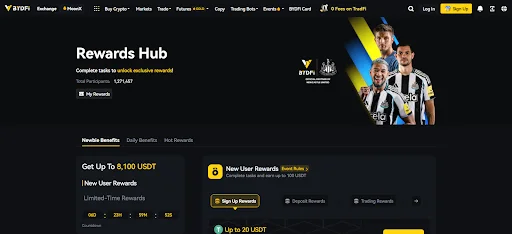
If you are looking to get set up before your next trip, BYDFi is currently running a crypto welcome bonus 2026 for new users — worth up to 8,100 USDT — which offsets some of the initial cost of funding your account. You can create a free account in a few minutes without needing to upload any documents to start.
Practical Tips for Using Crypto While Traveling
Stick to Stablecoins for Spending
If you are using crypto as a travel currency rather than an investment, keep your spending balance in USDT or USDC. Holding BTC or ETH in your travel wallet means your purchasing power moves with the market. A sudden 10% price drop on the day you need to pay for accommodation is a bad time to learn this lesson.
Keep a Small Local Currency Reserve
Crypto acceptance has grown, but cash is still king in rural areas, local markets, and smaller towns across much of the world. Arrive with enough local currency for the first day or two while you get oriented. Crypto works best as your primary card for merchant and ATM use, not as your only option in places with limited infrastructure.
Enable Withdrawal Whitelisting
If your exchange supports it — and BYDFi does — set up a withdrawal whitelist so that any transfer to a new address requires explicit approval from you. This means that even if someone gets access to your account credentials, they cannot send funds to an address you haven’t already authorized. Set this up before you leave home.
Screenshot Your Backup Codes
If you lose your phone abroad with your authenticator app on it, recovering 2FA access while traveling can be a significant headache. Store backup codes in a secure, offline location before you leave — a printed sheet in your luggage, a secure note in your password manager, or both.
The Bottom Line
Using crypto while traveling in 2026 is practical in a way it simply was not five years ago. The infrastructure exists — cards that work anywhere, platforms that get out of your way, and a growing list of merchants who accept direct crypto payments. The main thing required is choosing the right tools before you leave Crypto While Traveling.
A crypto debit card funded with stablecoins, combined with a small local cash reserve for the places that need it, covers the majority of travel spending scenarios without currency exchange hassle, foreign transaction fees, or bank blocks in unfamiliar territories. It is not a complete replacement for traditional travel banking yet — but for a growing number of travelers, it is quickly becoming the first choice.
Go beyond the basics—explore our complete collection of tips The Tipsy Gypsies.