

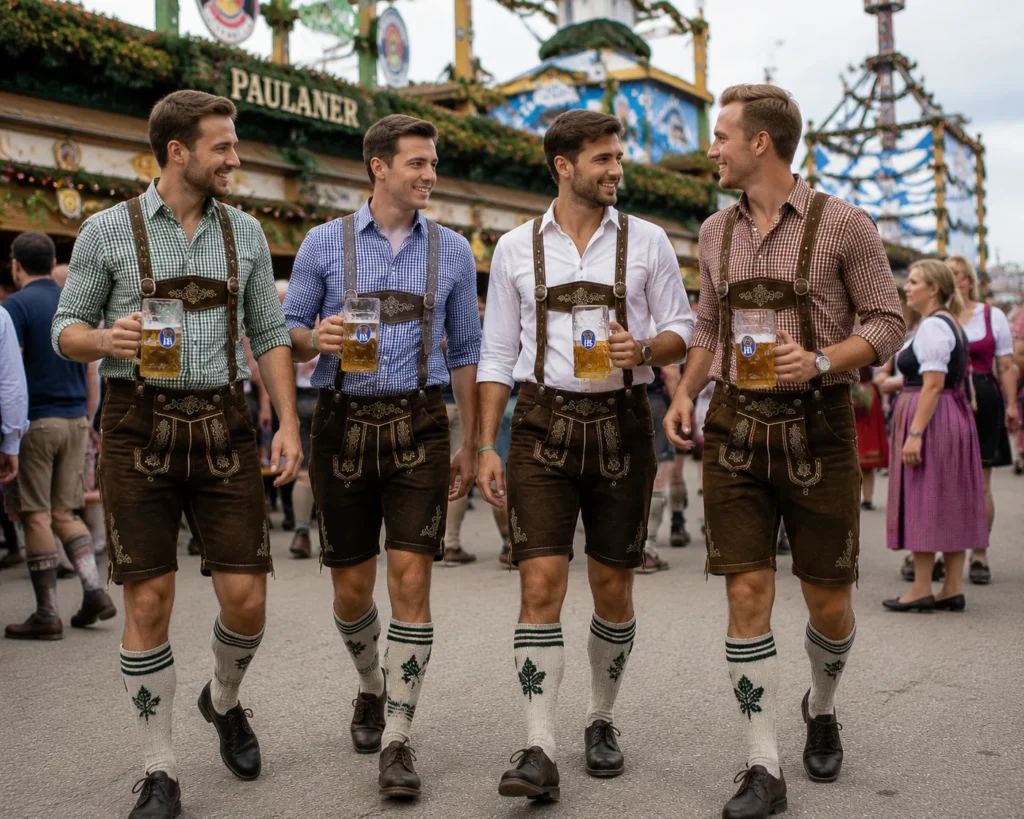
In the world of authentic Bavarian dress, there’s a specific category of garment that experienced wearers obsess over and beginners almost universally skip: the trachten sock. The traditional knee-high wool sock that fills the visible space between the lederhosen hem and the haferl shoes. The piece that, when done right, elevates an outfit from “guy in lederhosen” to “guy who knows what he’s doing.” When done wrong, it undermines every other expensive piece in the outfit or Mens Oktoberfest Outfit Needs.
Most first-time buyers of Bavarian wear focus on the lederhosen, the shoes, and the hat. They ignore the socks until the morning of their first event, then panic and substitute regular tall socks from their drawer. The result is an outfit that’s 90% authentic with one element that visibly breaks the heritage feel.
This is the honest review of the trachten sock — what makes it different from regular socks, why it matters for your mens oktoberfest outfit, and how to choose the right one for 2026.
What a Trachten Sock Actually Is
The term “trachten” refers to traditional regional German dress, particularly Bavarian and Austrian heritage clothing. A trachten sock is the specific knee-high wool sock designed to be worn with lederhosen and other traditional Bavarian outfits.
The defining features:
Length: Knee-high. Real trachten socks reach to just below the kneecap, where the top section folds down to create the structured visible cuff that’s part of the traditional aesthetic.
Material: Pure wool or quality wool blend. Traditional construction uses heavyweight wool that breathes well, retains shape, and ages gracefully over years of wear.
Cuff construction: The top 4-5 inches features a structurally distinct ribbed knit pattern designed specifically to fold down and create the visible cuff. This is the visual element that makes a trachten sock immediately recognizable as authentic heritage wear.
Knit patterns:
- Plain ribbed: The most common and versatile pattern
- Cable knit: Traditional pattern adding visual texture
- Bavarian patterns: Regional traditional designs in the cuff
- Hand-knit details: Premium versions feature traditional handwork
Color: Cream, off-white, natural, charcoal gray, or brown. Each suits different lederhosen colors and event formality levels.
A quality trachten sock typically costs $30-$60 mid-range and $60-$120 for premium hand-finished versions.
Why a Trachten Sock Matters More Than You Think
The visible space between lederhosen and haferl shoes is approximately 6-10 inches of leg. In a properly assembled mens Oktoberfest outfit, this space is occupied by the trachten sock — which becomes the visual foundation that anchors the entire outfit.
Skip the proper trachten sock and substitute:
Regular athletic socks:
- Wrong material (synthetic looks plastic in photos)
- No structured cuff (creates visual gap)
- Wrong length (often too short)
- Wrong proportions to the outfit
Standard business dress socks:
- Too thin and lightweight
- Lacks the heritage construction
- Looks like office wear with lederhosen
- Doesn’t photograph correctly
Regular tall casual socks:
- Missing the structured ribbed cuff
- Often wrong color or fabric
- Looks like generic athletic wear
The result of any substitution is an outfit that reads visually wrong, even when every other element is premium quality. This is why trachten socks aren’t optional — they’re foundational.
Color Selection Guide
The color of your trachten sock determines how the entire outfit reads.
Cream / off-white trachten sock:
- Universal default for most events
- Works with virtually every lederhosen color
- Photographs cleanly in any lighting
- Appropriate from casual to semi-formal events
- The recommended first purchase
Charcoal gray trachten sock:
- More sophisticated alternative for evening events
- Pairs particularly well with darker brown or black lederhosen
- Less common but more refined when chosen
- Works in modern alternative Bavarian styling
Natural / heather trachten sock:
- Best for outdoor or rustic-themed events
- Pairs well with traditional tan or light brown lederhosen
- Less universally appropriate
- Specialty choice for established collections
Brown trachten sock:
- Specific traditional styling
- Pairs with matching-tone leather lederhosen
- Less common in modern wear
- Specialty for traditional heritage events
White trachten sock:
- More formal/uniform style
- Common in military pipe bands or specific traditional uniforms
- Less common in civilian Oktoberfest wear
For first-time buyers, cream is the smartest choice. It handles every event you’re likely to attend with one quality pair.
Wool Weight by Climate and Use
Beyond color, wool weight affects comfort throughout long Oktoberfest events.
Lightweight wool blend (200-280g):
- Summer Oktoberfest events
- Indoor warm venues
- Active days requiring breathability
- Less insulating
Medium-weight pure wool (280-380g):
- Year-round versatile choice
- Most events and most climates
- The recommended weight for first purchase
- Holds shape well over years
Heavyweight wool (380g+):
- Cold-weather outdoor events
- Maximum insulation
- More dramatic visual presence
- Can be too warm for indoor events
For most buyers, medium-weight pure wool delivers the best year-round versatility.
How to Wear Trachten Socks Properly
Most beginners get the positioning wrong. The proper technique:
Step 1: Pull the sock fully up. The unfolded top edge should reach just below the kneecap.
Step 2: Fold the ribbed cuff down. Roll the structured top section down by 4-5 inches, creating the visible folded cuff.
Step 3: Position the fold at the right height. The folded edge should sit approximately two finger-widths below the kneecap.
Step 4: Match both legs identically. Use your fingers as measurement guides — 4 fingers, 5 fingers — to ensure exact symmetry.
Step 5: Check the cuff is straight. The fold should sit horizontally around the leg, not tilted or twisted.
Common positioning mistakes:
- Pulling socks too high (above the kneecap looks wrong)
- Asymmetric folds (different depths on each leg)
- Pulling socks too low (creates bunched appearance below the calf)
- Forgetting to fold the cuff at all (loses the structured look)
- Allowing the cuff to twist or slip during wear
Practice the positioning at home before your first event. The motor skill is simple but requires familiarity to execute quickly and consistently.
Quality Indicators Worth Verifying
When evaluating a trachten sock for purchase, verify these specifications:
Required for authentic quality:
- Pure wool fabric or quality wool blend (60%+ wool minimum)
- Specified knit pattern in product description
- Structurally distinct cuff section
- Reinforced heel and toe areas
- Quality construction visible in close-up photos
- Specific sizing (S/M/L tied to calf circumference)
- Origin information when possible
Premium tier features:
- Hand-knit detailing on cuff
- Traditional Bavarian patterns
- Reinforced stress points
- Heritage maker provenance
- Premium wool blends with cashmere or alpaca
- Specific country of origin (Germany or Austria)
Quality red flags:
- Pure synthetic fabric marketed as “wool-look”
- Vague material descriptions
- Generic S/M/L sizing without specific measurements
- Suspiciously low pricing (under $15 for “authentic” trachten socks)
- Stock photos that don’t show construction details
- Marketing emphasizing visual appearance over construction
A quality mid-range trachten sock ($35-$55) delivers genuine wool construction and structured cuff design. Cheap synthetic versions are categorically different products despite similar appearance in product photos.
Common Trachten Sock Mistakes
The errors that consistently appear at first events:
Mistake 1: Substituting regular tall athletic socks. The most common beginner mistake. Athletic socks lack the structured cuff and proper materials.
Fix: Buy actual trachten socks. The $30-$60 investment is essential.
Mistake 2: Wrong color choice. Pure white trachten socks with brown lederhosen creates jarring contrast. Black socks with light brown lederhosen looks mismatched.
Fix: Cream is universal with any lederhosen color. Match charcoal to darker leather only.
Mistake 3: Wrong cuff fold depth. Folding too shallow (1-2 inches) creates a thin band; folding too deep (6+ inches) creates oversized cuff.
Fix: Aim for 4-5 inches of folded cuff. Use fingers as measurement guide.
Mistake 4: Synthetic fabric labeled as wool. Some cheap products misrepresent material content.
Fix: Verify wool content percentage in product specifications. Pure wool or 60%+ wool blend only.
Mistake 5: Improper care that damages wool. Machine washing on hot, tumble drying — both destroy wool socks within months.
Fix: Hand-wash in cold water with mild wool detergent. Lay flat to dry. Treat like a wool sweater.
Mistake 6: Not using calf warmers when appropriate. For maximum traditional authenticity, calf warmers (Wadlstrümpfe) worn between sock and lederhosen add significant heritage character.
Fix: For established outfit collections, add calf warmers in matching color.
How Trachten Socks Complete the Mens Oktoberfest Outfit
The complete mens oktoberfest outfit assembly order:
- Lederhosen (the centerpiece)
- Trachten sock (knee-high cream wool — the visual foundation)
- Calf warmers (optional, for full traditional authenticity)
- Haferl shoes (proper Bavarian leather shoes)
- Trachten shirt (white, cream, or red-white check)
- Suspenders (often integrated with lederhosen)
- Belt (with appropriate buckle)
- Vest (optional, for formal evening events)
- Bavarian hat (with feather or brush detail)
- Accessories (edelweiss pin, watch chain, etc.)
The trachten sock is item 2 in this sequence — the second piece of the outfit that wearers actually put on. Skip it and the rest of the outfit fails to read as authentic. Include quality versions and even mid-range lederhosen looks premium.
Building a Trachten Sock Collection Over Time
For most Oktoberfest enthusiasts, the right collection sequence:
Year 1: Foundation
- 1 pair cream wool trachten socks (universal)
- Total: $30-$60
Year 2: Expansion
- Add 1 pair charcoal gray trachten socks
- Add calf warmers matching primary sock color
- Total adds: $60-$130
Year 3+: Refinement
- Add lightweight pair for summer events
- Add hand-knit premium pair for special occasions
- Add specialty colors if specific events require
- Total adds: $80-$180
A complete trachten sock collection rarely exceeds $250 total across years and lasts 5-10+ years with proper care.
Frequently Asked Questions
Are trachten socks the same as regular knee-high wool socks?
No. The structured ribbed cuff designed for folding is the defining feature. Regular knee-high wool socks lack this construction and don’t create the proper visual at the cuff.
Can women wear trachten socks?
Yes, with female Bavarian outfits. Female-sized versions exist with similar construction principles but proportioned for women.
Do trachten socks shrink after washing?
Quality wool versions are pre-shrunk and maintain size with proper care. Cheap versions may shrink significantly when washed incorrectly.
Should trachten socks be tight or loose?
Snug but not constricting. Properly sized socks grip the calf naturally without restricting circulation, staying positioned throughout long-day wear.
How do I prevent trachten socks from slipping down?
Quality construction with proper elasticity prevents slipping. Some traditional wearers use sock garters historically. Modern quality wool with proper sizing usually doesn’t require garters.
Can I wear trachten socks with non-Bavarian outfits?
Not really. The specific construction and styling is designed for traditional Bavarian wear. Wearing them with other outfit categories creates visual confusion.
The trachten sock is the silent foundation of every authentic mens Oktoberfest outfit. Skip it and substitute regular socks, and the entire outfit reads as half-assembled costume. Choose quality cream wool with proper construction, fold the cuff correctly, and you have the visual anchor that makes the rest of your heritage wear look right. It’s the smallest investment in your Oktoberfest setup and the one that signals to experienced wearers that you understand what you’re doing. Get it right first, and everything above the calves follows naturally.