
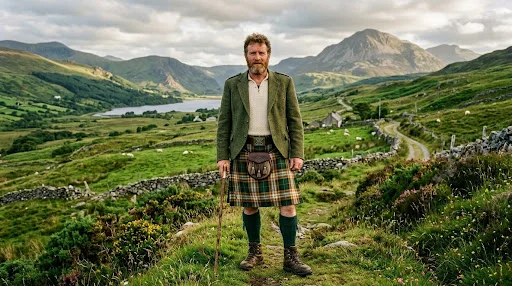
There’s a quiet difference between Scottish and Irish kilt traditions that most casual observers miss. Scottish kilts are tartan — pattern-based, woven in setts, tied to specific clans and families. Irish kilts are traditionally solid, in colors like saffron yellow, with patterns being a much later borrowing from Scottish neighbors.
But there’s one Irish tartan that has become genuinely accepted: the Irish National Tartan. And while it lacks the centuries of clan history that Scottish tartans carry, it makes up for it with something rarer — every plaid colour in the pattern has a deliberate, documented meaning tied directly to Irish identity.
Most people who own an Irish National Tartan kilt don’t know any of this. They bought the pattern because it looked Irish. They didn’t realize they were wearing a coded statement about Irish geography, history, and identity, all woven into a single piece of cloth.
Here’s what each of the six plaid colours in the Irish National Tartan actually represents, and what it means to wear all of them together.
The Origin: How the Irish National Tartan Came to Be
Unlike Scottish tartans, which evolved gradually over centuries, the Irish National Tartan has a clear, documented birth.
It was designed in the 1990s as a solution to a specific problem: Irish-Americans, Australian-Irish, and the broader Irish diaspora wanted a kilt option, but Ireland’s traditional kilt is solid saffron — not patterned. For wearers who wanted a tartan but had no connection to a specific Irish county tartan, there was a gap in the market.
The Irish National Tartan was registered with the Scottish Tartan Society to fill that gap. It was designed deliberately to incorporate symbolism from across Ireland rather than being tied to one region or county. This is what makes its colour meanings so specific and intentional.
Today, the Irish National Tartan is one of the most popular Irish tartans worldwide — and it’s the default choice for anyone of Irish heritage who doesn’t have a specific county or family pattern to wear.
The Six Plaid Colours and What They Mean
The pattern uses six distinct colours, each chosen for symbolic reasons. Here’s the full breakdown.
1. Green — The Land of Ireland
Green is the dominant colour in the Irish National Tartan, and it represents the most obvious thing: the green fields of Ireland itself. The Emerald Isle isn’t just a marketing slogan — Ireland’s lush, rain-fed landscape genuinely is more vibrantly green than almost any other country in Europe.
In Irish heraldry, green has been associated with the country since at least the 1640s, when the United Irishmen used it as a symbol of identity against British red. Today it’s the colour most directly tied to Irish national identity worldwide.
In the tartan, green takes up the most space because it represents the land itself — the foundation everything else rests on.
2. Gold (or Saffron) — Ancient Irish Heritage
The gold or saffron colour in the Irish National Tartan is a deliberate nod to Ireland’s pre-Christian Gaelic heritage. As covered earlier in this guide, saffron was the prized dye colour of the medieval Irish léine — the long tunic that preceded the kilt as Ireland’s traditional male garment.
Including saffron in the national tartan acknowledges this ancient layer of Irish identity, before British rule, before partition, before the Irish state existed in its modern form. It connects the modern tartan to over 1,000 years of Irish dress history.
For wearers, this colour is a quiet acknowledgment that being Irish is older and deeper than any one century or political moment.
3. Orange — The Northern Tradition
Orange is the most politically loaded colour in the entire pattern, and its inclusion was a deliberate choice.
Orange has historically been associated with Northern Irish Protestant identity, dating back to William of Orange’s victory at the Battle of the Boyne in 1690. The Orange Order, the Loyal Orange Lodge, and the Protestant tradition in Ulster all use orange as their identifying colour.
By including orange in the Irish National Tartan, the designers made a unifying statement: that this pattern represents all of the Irish identity, including the Protestant and Northern traditions, not just Catholic and Republican Ireland.
This is the same logic behind the Irish flag, which deliberately places green (representing Catholic and Gaelic Ireland), orange (representing Protestant and Ulster traditions), and white (representing peace between them) in equal vertical bands. The Irish National Tartan adopts the same symbolism.
For wearers, this colour makes the tartan a statement of inclusive Irish identity rather than a partisan one.
4. White — Peace and Unity
White serves the same function in the tartan that it does in the Irish flag: it represents the peace and shared identity that bridges the green and orange traditions.
White is also a colour with deep roots in Irish mythology and Celtic Christianity. White represented spiritual purity, the cloak of the Druid, and the dress of Saint Patrick himself in many traditional accounts. White was the colour of bardic poets and learned figures across Gaelic society.
In the modern tartan, white provides visual breathing space — letting the bolder colours stand out — while symbolically representing the unity that holds the whole national identity together.
5. Brown — The Soil and Bog
Brown is the most overlooked colour in the pattern, and the most specifically Irish in its symbolism.
Brown represents the Irish soil — particularly the rich, dark peat bogs that cover roughly 17% of Ireland’s landmass. Bogs aren’t just landscape features in Ireland; they’re cultural touchstones. They preserved Iron Age artifacts, including the famous bog bodies and Celtic gold hoards. They provided fuel for centuries of Irish homes through cut peat (turf). They feature in countless poems, songs, and folk stories.
When a wearer puts on the Irish National Tartan, the brown stripes are quietly representing the deep, peat-rich earth that Ireland is built on — the unromantic but essential layer of national identity.
It’s the colour most likely to make a knowledgeable Irish person nod with approval when they understand it’s there.
6. Black (Subtle Overcheck) — Endurance Through Hardship
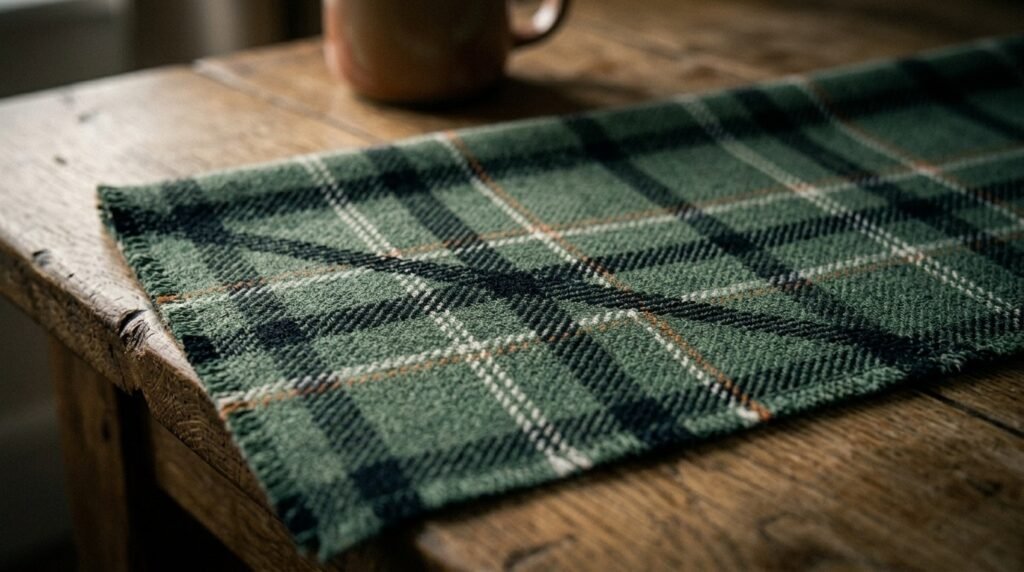
The fine black overcheck running through the Irish National Tartan represents something darker and more sobering: the suffering and endurance of the Irish people through centuries of hardship.
The Great Famine of 1845-1852, in which roughly one million Irish people died and another two million emigrated, fundamentally reshaped Irish identity. The centuries of British rule, the Plantations, the Troubles, the diaspora — all of these are layered into Irish historical consciousness.
The black thread doesn’t dominate the tartan, but it runs through everything else, much like the memory of these hardships runs through Irish culture without defining it. It’s a small but deliberate acknowledgment that the green fields and gold heritage and orange-and-white unity all exist in spite of everything that tried to destroy them.
How the Six Colours Work Together Visually
Here’s where the design genuinely succeeds. The six plaid colours aren’t just thrown together — they’re proportioned to create a coherent visual hierarchy:
- Green dominates (representing the land that contains everything else)
- Gold and orange anchor the visual rhythm with strong but balanced presence
- White provides clear definition between the bolder colours
- Brown adds depth and grounding without competing for attention
- Black overcheck provides texture and shadow
Stand back from an Irish National Tartan kilt and your eye reads it as primarily green with vibrant accents. Move closer and you see the layered symbolism. Both views work, which is the mark of a well-designed pattern.
When to Wear the Irish National Tartan
The pattern is genuinely versatile across Irish-themed and Celtic occasions:
- St. Patrick’s Day events where you want to show Irish heritage authentically
- Irish weddings where the family doesn’t have a specific county tartan
- Irish-American family gatherings and heritage celebrations
- Celtic festivals worldwide
- Pipe band performances where the band has chosen this tartan
- Memorial events for Irish historical commemorations
It’s slightly more formal-looking than the saffron kilt and slightly less formal-looking than a Scottish clan tartan, sitting in a useful middle ground.
Pairing the Tartan With Accessories
The strong green base with multiple accent colours makes accessory pairing straightforward:
- Cream or off-white kilt hose — connects to the white in the tartan
- Green or red flashes — picks up the dominant green or warmer accents
- Dark brown leather sporran — connects to the brown in the tartan (and reads warmer than black with this specific pattern)
- Black ghillie brogues for formal events; brown for casual
- Cream or pale shirt under any jacket
- Solid tie in green, navy, or burgundy — never patterned, which would compete
Avoid heavy ornamentation. The tartan does enough visual work on its own.
Frequently Asked Questions
Is the Irish National Tartan a real, registered tartan?
Yes. It’s registered with the Scottish Register of Tartans, the official global registry for tartan patterns.
When was it actually designed?
The 1990s. It’s a modern design, not an ancient one — but its symbolism is rooted in older Irish traditions.
Can I wear it if I have no Irish ancestry?
The Irish National Tartan is more open than Scottish clan tartans. Anyone connecting to Irish culture respectfully — through events, friends, or appreciation of Irish heritage — can wear it without offending. It’s not a clan-specific pattern.
Is the Irish National Tartan more authentic than the saffron kilt?
It’s more recent. The saffron kilt represents older Irish dress traditions. The Irish National Tartan represents a modern unified Irish identity. Both are legitimate but represent different layers of Irish heritage.
Are there other Irish tartans?
Yes, including specific county tartans for almost every Irish county, plus family tartans like O’Brien, O’Donnell, and others. The Irish National Tartan is the default for those without a specific connection.
What’s the difference between Irish National Tartan and Saint Patrick’s Tartan?
Different patterns with different symbolism. Saint Patrick’s Tartan is older and uses different colour proportions. The Irish National Tartan is more contemporary and includes the orange-green-white symbolism specifically tied to the modern Irish state.
When you wear the Irish National Tartan, you’re not wearing decoration. You’re wearing a deliberate statement about Irish identity in all its complexity — the green land, the saffron heritage, the orange and green unity, the white peace, the brown soil, and the black overcheck of hardship endured. Six colours. One pattern. Centuries of identity woven together.